Foreign Accent
In our daily life, we are aware of the existence of accent, especially when having a conversation with foreigners from other countries. For example, we can identify a person whether his is from China or Taiwan by the pronunciation of words with retroflex sounds.
The first website below is a phonetic database of different language speakers reading the same article. The other is a clip about one man who can imitate about 100 people’s voice, which shows that every people has different way of speaking and, of course, different voice quality.
The speech accent archive (QuickTime required)
The Man of Another 100 Voices
In some special cases, people starts to speak with another voice and tone, like he or she is possesed by some demon. In fact, it's your brain again. Visit these websites below to get further information.
Foreign Accent Syndrome
Possession? No, brain damage
2008年1月4日 星期五

The Biological Bases of Speech Production (2)
The Vocal Tract and Related Speech Organs
A. Vocal cord mechanism
The first website
Vocal tract visualization laboratory
The next two are about some vocal tract models which can make voice as human voice.
Vocal tract quartet (artificial vocal tract model)
Vocal tract model synthesis (experiment clip)
The last two clips show the vocal cord vibration.
Inside the Voice (voice box's self-introduction)
Vocal vibration (female singer)
B. Speech organs introduction
Diagram of the organs of speech
Speech organs location

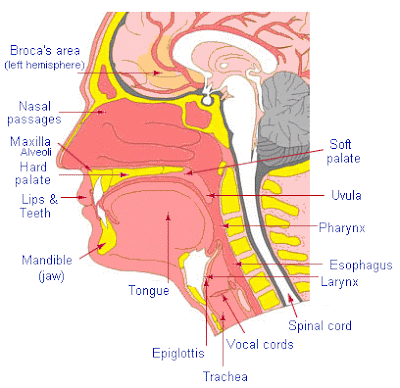
click on the picture to visit the original page!
▲ brain (quoted from Medem)
Lips (labial)
Teeth (dental)
Tongue
Alveolar
Palate (palatal)
Velum (velar)
Uvula (uvular)
Glottis (glottal)
sounds by IPA-UCLA
The Biological Bases of Speech Production (1)
Connections between Auditory and Speech Mechanisms
First, let's try to read out the WORDS below as fast as you can.
紅 藍 黃 白 綠 藍 紅 白 黃
Now, try this one below:
藍 白 綠 紅 藍 黃 白 綠 紅
How is your reading of the first string? How is that about reading the latter one? I know that you felt confused while reading the second one and it seems to be hard to read it right and fast as you do the first one. Why? We may say that our brains are fooled by the colors of each word especially when they are not match to the word's meaning. It shows some connections between reading and speaking and also some independencies. What about other senses we have? Let's visit the website below to discover.
http://www.eng.mu.edu/rehab/Rehab167/Mod2/hearing/
The pictures below can help you to understand the location of each organs mentioned in the website.
 ▲ anatomy of the vocal tract (from PATTS)
 ▲ ear diagram (from The Stanford Health Library)
First, let's try to read out the WORDS below as fast as you can.
紅 藍 黃 白 綠 藍 紅 白 黃
Now, try this one below:
藍 白 綠 紅 藍 黃 白 綠 紅
How is your reading of the first string? How is that about reading the latter one? I know that you felt confused while reading the second one and it seems to be hard to read it right and fast as you do the first one. Why? We may say that our brains are fooled by the colors of each word especially when they are not match to the word's meaning. It shows some connections between reading and speaking and also some independencies. What about other senses we have? Let's visit the website below to discover.
http://www.eng.mu.edu/rehab/Rehab167/Mod2/hearing/
The pictures below can help you to understand the location of each organs mentioned in the website.
▲ anatomy of the vocal tract (from PATTS) ▲ ear diagram (from The Stanford Health Library)It seems like hearing and speaking are too relative to be apart, but some people are born with hearing loss and still can speak like speaking people. Now, we will get to know about hearing loss, and how do deaf people learn to speak.
2008年1月1日 星期二
The Biological Bases of Speech Production (0)
Dogs and cats in the house, horses and sheep in the barn, whales and dolphins in the ocean, even insects in the forest, all of these creatures can make distinct sounds (including some ultrasounds which cannot be heard by human), and some of them can imitate human voice and even give a great interaction, watch the clip below and give this smart fowl fellow a big hand!
So, how about we humans? Are we competent enough to bit the bird?
Let's see the limitation of human voice:
Georgia Brown-Brazilian singer (see whistle register)
Basso profundo-the lowest note
Dean Frenkel (harmonical singer)
So far, we are only aware of the pitches that human beings can make, in the next section, we are going to think about the connections between auditory and speech mechanisms, and see how brain works when we are talking. And in section 2 we will try to discover how the vocal tract works to produce speaking voices. In the last section, we are going to focus on the accent of speech, and discuss the cause.
訂閱:
文章 (Atom)