LB91-94 晟維
(Chapter 3, Section 3)
We cannot state exactly the number of muscles that are necessary for speech and that are active during speech. But if we consider that ordinarily the muscles of the thoracic and abdominal walls, the neck and face, the larynx, pharynx, and the oral cavity are all properly coordinated during the act of speaking, it becomes obvious that over 100 muscles must be controlled centrally. Since the passage from any one speech sound to another depends ultimately on differences in muscular adjustments, fourteen times per second an "order must be issued to every muscle," whether to contract, relax, or maintain its tonus. From Fig. 3.6 it is clear, however, that the readjustment does not occur simultaneously for all muscles but that various groups of muscles have characteristic timing; some are active shortly before the acoustic onset of a phoneme, some during, and some shortly after. Thus we gather that the rate at which individual muscular events occur (throughout the speech apparatus) is of an order of magnitude of several hundred events every second. It is evident that the activation of so many muscles in such a short time span cannot depend on volition alone. There must be some automatisms—whole trains of events that are "preprogrammed" and run off automatically. Automatic sequences such as these are called synergisms; they form the basis of all motor phenomena in vertebrates. The physiology of speech production would be very simple if every phoneme were associated with one and only one pattern of muscular interaction. However, this is not what we find. The muscular activity associated with one phoneme is influenced by the phonemes that precede and follow it. Thus the motor patterns that we must investigate here are complex motor configurations that extend over relatively long periods, as in the duration of a syllable or word.
我們無法精準地將說話所需要的肌肉及說話時所用到的肌肉一一地列舉出來。但如果我們把胸壁及腹壁上普遍的肌肉都考慮進來,還有頸部和臉部、咽、喉及口腔等在說話時能精確地相互合作的肌肉,很明顯地,有超過一百條肌肉必須受到中央控制。因為任何一段語音基本上都依靠肌肉不同的調節,每秒有十四次的「指令必須傳達至每條肌肉」,不論是要收縮、放鬆或維持緊張度。從圖3.6可以清楚看到,儘管每條肌肉的調節並非同時發生,而是不同的肌肉群所特有的時間控制,有些肌肉在一個音素的聽覺開端前一段短時間就開始動作,有些同時,有些則在一段短時間之後。 因此我們推想所有發聲器官裡每一個獨立肌肉事件的發生,就如同每一秒內有好幾百個重要事件的命令。很明顯的,要讓如此大量的肌肉在這麼短的時間內啟動,並不能只依靠意志。一定有某些自動現象存在:一連串「預先程序化」的事件自動自發的進行著。這樣自動化的順序稱為連合作用;此作用形成脊椎動物動作現象的基礎。如果每一個語音音素只跟一個肌肉相互作用模式有關,那麼言語產生的生理學就再簡單不過了。但是,這並不是我們所尋求的。一個音素所涉及的肌肉活動會受到該音素的前一個及後一個音素影響。我們在這裡必須探討的動作模式是複雜動作型態,其可擴展至相當長的一個時段,如一個音節或一個詞彙的長度。
The intricacy of the problem becomes apparent if we draw an analogy between the sequence of events during speech and in drumming with the fingers on a table top. Both proceed at a rapid rate, but when we drum out a melody with our fingers, it does not matter in which order each finger falls on the table. The easiest is to use a single order, letting the small finger always be the first and the index always the last. But in speech production the order of activation and precise timing is of paramount importance.
這個問題的複雜性可藉由「說話中事件發生的順序」與「用手指敲擊桌面」兩件事的比擬,而變得顯而易懂。這兩件事都以高速進行,但是當我們用手指敲擊桌面的時候,手指敲擊的順序並不重要。最簡單的方式是:從小指到食指依序敲擊。但是在言語產生的過程中,動作的順序及精確的時間點便有最高的重要性。
(3) Ordering of Articulatory Events
(3) 發聲事件的順序
The problem of order in speech and language is not confined to articulation. We can speak of an order of events at the level of perception of acoustic phenomena, of articulation, and of nerve impulses. The perceptual order of speech sounds need not be identical with the order of acoustic correlates (we may ignore or fail to hear certain acoustic phenomena); the order of acoustic events need not be identical with the order of motor or articulatory events (movements occur that do not produce sound or sound-changes); the order of central neuronal events may be different from the order of peripheral motor events. (Certain nervous impulses must be initiated in advance of others because traveling time to the periphery is longer for some pathways than others.)
言語及語言順序的問題並不侷限於發聲過程。我們可以談論接收聲學現象的事件順序、發聲的事件順序及神經脈衝的事件順序。言語的接收順序似乎不必與聲學相關的順序一致(我們可能忽略或聽不到某種聽覺現象);而聽覺事件的順序也不必與發聲事件的動作順序一致(動作的發生並不會產生聲音或改變聲音);而中央神經事件的順序,可能也和半腦動作的事件順序不同。(特定的神經脈衝必須先於其他的神經脈衝,因為半腦的巡迴時間對某些途徑來說比其他的更長。)
Figure 3.7 shows the spectrogram of a male speaker saying the words "Santa Claus." No matter how carefully or how often we listen to these tape-recorded words played back at the original speed, we always hear a clear-cut sequence of phones, one beginning at the termination of the previous one. However, the graphic representation demonstrates that, acoustically, phones overlap. The initial portion of a vowel may bear the acoustic clues of the stop-consonant preceding it; the last portion of the lateral /l/ may have the vowel coloring of the next sound; or, in general, vowels and consonants influence each other acoustically (Delattre et al., 1955; Stevens and House, 1963). Thus the onset of a phone is different when defined acoustically than perceptually, with the acoustic onset often preceding the perceptual one.
圖3.7為一名男子說「Santa Claus」的聲譜圖。無論多小心的重複聆聽以原速播放的錄音,我們總能聽到清楚的語音順序,後一個的開頭接著前一個的結尾。然而,圖3.7卻顯示語音有聲學上的重疊。在母音開頭的部分,帶有前一個塞音的聲學跡象;而/l/最後的部分則受到下一個音的母音影響;或者,一般而言,母音和子音在聲學上互相影響(Delattre et al.,1955; Stevens and House, 1963)。所以,一個語音的開頭在聲學及聽覺上有所不同,而聲學所定義的開頭總在聽學之前。
There are many articulatory events, or more generally, motor events, that leave no trace on spectrograms. Figure 3.6 based on work by Stetson show this very clearly. Before the onset of phonation, muscles in the abdominal and thoracic wall and in the larynx have to assume certain positions, with some of these events preceding the onset of sound by 100 milliseconds (msec) and more. Also during those silent periods which appear as short blanks on spectrograms a great many movements are performed, particularly by the tongue, which must get into position for alveolar or palatal stops (d, t, g, k) or which gets ready for the production of the next vowel.
有許多的發聲事件(或更廣義的說,動作事件)並不會在光譜圖上留下遺跡。圖3.6依據Stetson的研究顯示了這樣的現象。早在發音的開頭之前,腹壁、胸壁及咽喉的肌肉必須擔任特定的職位,而某些發聲事件在聲音的開端前100多毫秒(甚至更長)之前就開始了。同時在無聲的期間(也就是聲譜圖上空白的部分),許多動作已經開始,尤其是舌頭的動作,因為在發出齦顎塞音、軟顎塞音及下一個母音的發音前,就必須在發聲位置上。
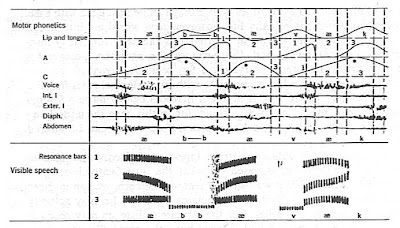 (FIG 3.6)
FIG. 3.6 Earlier observations on the relationship and timing of certain muscular activities and sound production.(After Stetson, 1951.)
圖3.6 有關特定肌肉的活動及語音的產生之間的關係及時間點的較早的觀察。.(根據 Stetson, 1951.)
 (FIG 3.7)
FIG. 3.7 Perceptually, speech sounds seem to follow one another like a train of independent speech segments. Acoustically, however, there is considerable overlap. (a) Spectrogram of the words Santa Claus. Vertical lines mark acoustically differentiated segments. (b) Assignment of phonemes to acoustic segments.(From Fant and Lindblom, 1961.)
圖3.7 從感知方面來看,語音似乎像是獨立語段一長串的連結。然而,從聲學角度來看,語音之間存在著相當大部分的重疊。(a)「Santa Claus」的聲譜圖。重直線標示出聲學上相異的語段。 (b)音素在聲學上分段的配置。(節自Fant 及 Lindblom, 1961.)
(Vocabulary Searching)
thoracic 【解】胸的、胸廓的
abdominal 【解】腹的、腹部的
tonus 【生】緊張度
magnitude 巨大,廣大[U] / 重大,重要[U] / 量;大小;強度;音量[U] /【天】星等(指星的亮度)[C] /【地】震級[C]
volition 意志;決斷力 / 選擇;決定
synergism【醫】(各種藥物的)連合作用 /【宗】神人協力合作說
configuration結構;表面配置 /【心】形態 /【天】行星的方位;(地球表面的)外貌


