2008年10月29日 星期三

LB092-094 晟維

LB91-94 晟維
(Chapter 3, Section 3)
We cannot state exactly the number of muscles that are necessary for speech and that are active during speech. But if we consider that ordinarily the muscles of the thoracic and abdominal walls, the neck and face, the larynx, pharynx, and the oral cavity are all properly coordinated during the act of speaking, it becomes obvious that over 100 muscles must be controlled centrally. Since the passage from any one speech sound to another depends ultimately on differences in muscular adjustments, fourteen times per second an "order must be issued to every muscle," whether to contract, relax, or maintain its tonus. From Fig. 3.6 it is clear, however, that the readjustment does not occur simultaneously for all muscles but that various groups of muscles have characteristic timing; some are active shortly before the acoustic onset of a phoneme, some during, and some shortly after. Thus we gather that the rate at which individual muscular events occur (throughout the speech apparatus) is of an order of magnitude of several hundred events every second. It is evident that the activation of so many muscles in such a short time span cannot depend on volition alone. There must be some automatisms—whole trains of events that are "preprogrammed" and run off automatically. Automatic sequences such as these are called synergisms; they form the basis of all motor phenomena in vertebrates. The physiology of speech production would be very simple if every phoneme were associated with one and only one pattern of muscular interaction. However, this is not what we find. The muscular activity associated with one phoneme is influenced by the phonemes that precede and follow it. Thus the motor patterns that we must investigate here are complex motor configurations that extend over relatively long periods, as in the duration of a syllable or word.

我們無法精準地將說話所需要的肌肉及說話時所用到的肌肉一一地列舉出來。但如果我們把胸壁及腹壁上普遍的肌肉都考慮進來,還有頸部和臉部、咽、喉及口腔等在說話時能精確地相互合作的肌肉,很明顯地,有超過一百條肌肉必須受到中央控制。因為任何一段語音基本上都依靠肌肉不同的調節,每秒有十四次的「指令必須傳達至每條肌肉」,不論是要收縮、放鬆或維持緊張度。從圖3.6可以清楚看到,儘管每條肌肉的調節並非同時發生,而是不同的肌肉群所特有的時間控制,有些肌肉在一個音素的聽覺開端前一段短時間就開始動作,有些同時,有些則在一段短時間之後。 因此我們推想所有發聲器官裡每一個獨立肌肉事件的發生,就如同每一秒內有好幾百個重要事件的命令。很明顯的,要讓如此大量的肌肉在這麼短的時間內啟動,並不能只依靠意志。一定有某些自動現象存在:一連串「預先程序化」的事件自動自發的進行著。這樣自動化的順序稱為連合作用;此作用形成脊椎動物動作現象的基礎。如果每一個語音音素只跟一個肌肉相互作用模式有關,那麼言語產生的生理學就再簡單不過了。但是,這並不是我們所尋求的。一個音素所涉及的肌肉活動會受到該音素的前一個及後一個音素影響。我們在這裡必須探討的動作模式是複雜動作型態,其可擴展至相當長的一個時段,如一個音節或一個詞彙的長度。


The intricacy of the problem becomes apparent if we draw an analogy between the sequence of events during speech and in drumming with the fingers on a table top. Both proceed at a rapid rate, but when we drum out a melody with our fingers, it does not matter in which order each finger falls on the table. The easiest is to use a single order, letting the small finger always be the first and the index always the last. But in speech production the order of activation and precise timing is of paramount importance.
這個問題的複雜性可藉由「說話中事件發生的順序」與「用手指敲擊桌面」兩件事的比擬,而變得顯而易懂。這兩件事都以高速進行,但是當我們用手指敲擊桌面的時候,手指敲擊的順序並不重要。最簡單的方式是:從小指到食指依序敲擊。但是在言語產生的過程中,動作的順序及精確的時間點便有最高的重要性。

(3) Ordering of Articulatory Events
(3) 發聲事件的順序

The problem of order in speech and language is not confined to articulation. We can speak of an order of events at the level of perception of acoustic phenomena, of articulation, and of nerve impulses. The perceptual order of speech sounds need not be identical with the order of acoustic correlates (we may ignore or fail to hear certain acoustic phenomena); the order of acoustic events need not be identical with the order of motor or articulatory events (movements occur that do not produce sound or sound-changes); the order of central neuronal events may be different from the order of peripheral motor events. (Certain nervous impulses must be initiated in advance of others because traveling time to the periphery is longer for some pathways than others.)
言語及語言順序的問題並不侷限於發聲過程。我們可以談論接收聲學現象的事件順序、發聲的事件順序及神經脈衝的事件順序。言語的接收順序似乎不必與聲學相關的順序一致(我們可能忽略或聽不到某種聽覺現象);而聽覺事件的順序也不必與發聲事件的動作順序一致(動作的發生並不會產生聲音或改變聲音);而中央神經事件的順序,可能也和半腦動作的事件順序不同。(特定的神經脈衝必須先於其他的神經脈衝,因為半腦的巡迴時間對某些途徑來說比其他的更長。)

Figure 3.7 shows the spectrogram of a male speaker saying the words "Santa Claus." No matter how carefully or how often we listen to these tape-recorded words played back at the original speed, we always hear a clear-cut sequence of phones, one beginning at the termination of the previous one. However, the graphic representation demonstrates that, acoustically, phones overlap. The initial portion of a vowel may bear the acoustic clues of the stop-consonant preceding it; the last portion of the lateral /l/ may have the vowel coloring of the next sound; or, in general, vowels and consonants influence each other acoustically (Delattre et al., 1955; Stevens and House, 1963). Thus the onset of a phone is different when defined acoustically than perceptually, with the acoustic onset often preceding the perceptual one.
圖3.7為一名男子說「Santa Claus」的聲譜圖。無論多小心的重複聆聽以原速播放的錄音,我們總能聽到清楚的語音順序,後一個的開頭接著前一個的結尾。然而,圖3.7卻顯示語音有聲學上的重疊。在母音開頭的部分,帶有前一個塞音的聲學跡象;而/l/最後的部分則受到下一個音的母音影響;或者,一般而言,母音和子音在聲學上互相影響(Delattre et al.,1955; Stevens and House, 1963)。所以,一個語音的開頭在聲學及聽覺上有所不同,而聲學所定義的開頭總在聽學之前。

There are many articulatory events, or more generally, motor events, that leave no trace on spectrograms. Figure 3.6 based on work by Stetson show this very clearly. Before the onset of phonation, muscles in the abdominal and thoracic wall and in the larynx have to assume certain positions, with some of these events preceding the onset of sound by 100 milliseconds (msec) and more. Also during those silent periods which appear as short blanks on spectrograms a great many movements are performed, particularly by the tongue, which must get into position for alveolar or palatal stops (d, t, g, k) or which gets ready for the production of the next vowel.
有許多的發聲事件(或更廣義的說,動作事件)並不會在光譜圖上留下遺跡。圖3.6依據Stetson的研究顯示了這樣的現象。早在發音的開頭之前,腹壁、胸壁及咽喉的肌肉必須擔任特定的職位,而某些發聲事件在聲音的開端前100多毫秒(甚至更長)之前就開始了。同時在無聲的期間(也就是聲譜圖上空白的部分),許多動作已經開始,尤其是舌頭的動作,因為在發出齦顎塞音、軟顎塞音及下一個母音的發音前,就必須在發聲位置上。
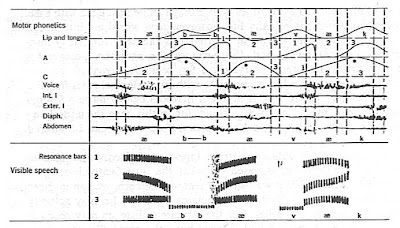
(FIG 3.6)
FIG. 3.6 Earlier observations on the relationship and timing of certain muscular activities and sound production.(After Stetson, 1951.)

圖3.6 有關特定肌肉的活動及語音的產生之間的關係及時間點的較早的觀察。.(根據 Stetson, 1951.)
(FIG 3.7)
FIG. 3.7 Perceptually, speech sounds seem to follow one another like a train of independent speech segments. Acoustically, however, there is considerable overlap. (a) Spectrogram of the words Santa Claus. Vertical lines mark acoustically differentiated segments. (b) Assignment of phonemes to acoustic segments.(From Fant and Lindblom, 1961.)
圖3.7 從感知方面來看,語音似乎像是獨立語段一長串的連結。然而,從聲學角度來看,語音之間存在著相當大部分的重疊。(a)「Santa Claus」的聲譜圖。重直線標示出聲學上相異的語段。 (b)音素在聲學上分段的配置。(節自Fant 及 Lindblom, 1961.)


(Vocabulary Searching)
thoracic 【解】胸的、胸廓的
abdominal 【解】腹的、腹部的
tonus 【生】緊張度
magnitude 巨大,廣大[U] / 重大,重要[U] / 量;大小;強度;音量[U] /【天】星等(指星的亮度)[C] /【地】震級[C]
volition 意志;決斷力 / 選擇;決定

synergism【醫】(各種藥物的)連合作用 /【宗】神人協力合作說

configuration結構;表面配置 /【心】形態 /【天】行星的方位;(地球表面的)外貌

2008年9月24日 星期三

LB447-448 晟維

The study of language entered a new phase in the second century B.C. By this time the Greek language had changed so much that the old texts of Homeric times were no longer readily understandable. The task of their interpretation fell to the so-called critics or grammarians who had to evaluate and judge the beauty of the old manuscripts. Formal grammar owes its beginnings and development to their efforts in the succeeding two-hundred years [17].4

在西元前二世紀,語言的研究進入了嶄新的一頁。這個時期的希臘語已改變甚多,連荷馬時期的古老文獻都無法輕易的瞭解。而翻譯的任務便落到了所謂的評論家及文法家身上了,他們得鑑定及評論古老文獻手稿之美。由於他們在接下來兩百年的努力,使得形式語法開始萌芽發展[17]。


One group among the grammarians represented by the greatest Alexandrine philologist, Aristarch (220-142 B.C.) and his school, was convinced that the meaning or origin of many old words could be derived by postulating that they had been modified or declined similarly to words with which they were familiar. They therefore contended that language was ruled by analogy. This principle was supposed to rule nature (physis) and permit the establishment of natural laws. But because language had not yet acquired any degree of standardization, the claims of the analogists were not as solidly based as we might be led to suppose [18].

文法家中其中一個團體,亞歷山大的哲學家Aristarch及其學派,相信能夠藉由假設他們已經將熟悉的字詞作相似的修飾及變格,推演出許多古老字彙的意義及根源。因此他們聲稱語言受到類比的規範。這個原則應該可以規範自然(physis)並允許自然法則的建立。但是因為語言尚未獲得任何程度的標準性,類比學家的主張並非如同我們被引導假設的那樣牢固可靠。


The analogists’ view was opposed by Krates, a philologist and grammarian, (came to Rome in 169 B.C.) and his school, who saw no lawfulness in language and, therefore, proclaimed its pervasion by anomaly (nomos). Anomaly was thought to be characteristic for everything made by man (nomos or thesis) [19]. Anomaly in language seemed to be confirmed by the observations which had already been made by Democritus (460-352 B.C.), that more than one name could apply to the same thing, that proper names could be changed and that analogy was frequently lacking. The standpoint of the anomalists was, in Steinthal’s opinion, the more solidly based in view of the paucity of grammatical rules. Yet at that time the argument could be used that language must be physis for otherwise neither blessing nor curse could have an effect [20].5 But neither the principle of analogy or of anomaly could provide, by itself, the basis for the establishment of a formal grammar which, of necessity, would have to be based on rules but would have to make allowances for exceptions as well.


類比學家的觀點遭到哲學家同時也是文法家的Krates(西元前169年來到羅馬)及其學派反對,他認為語言中沒有法則,因此也表示不規則(nomos)的普遍性。不規則性被認為是人類所創造事物的特點(nomosthesis) [19]。語言中的不規則性可說是由Democritus(西元前460-352年)所做的觀察而得到證實,例如不同名稱可使用在同一個事物上、專有名詞可以被改變,以及類比的情形並不常見等現象。依Steintahl來看,不規則學家的立場則是較確實地建立在語法規則缺乏的觀點上。此外,在當時的年代可提出語言必須是physis,否則無論是祝福還是詛咒都無法帶來影響 [20]。但是類比原則和不規則原則都無法單獨證明,形式語法建立的根基,必然需要根據規則同時也要准許例外的存在。


The establishment of a formal grammar became a pressing need in Roman times. Unlike their Greek predecessors, who had become preoccupied with language studies in their attempt to understand the classics, Roman men of letters required rules in order to write a Latin literature. Moreover, the standardization of Latin usage was of vital importance for the political aims of uniting the Roman Empire. The contribution of the Roman grammarians were primarily of a utilitarian nature and represent the application in practice of some Greek principles of thought. In the field of grammatical theory, Marcus Terentius Varro (116-27 B.C.) resolved the antithesis of anomaly versus analogy by finding a place for both analogy and anomaly in grammar. For him language was a natural ability which had been subjected to cultural development [21].

形式語法的建立在羅馬時期變成了一種急切的需要。跟他們的希臘先驅不同的是,他們為了瞭解古典名著而對語言研究變得全神貫注,羅馬的作家需要規則才能書寫拉丁文的作品。除此之外,因為統一羅馬帝國的政治目的,拉丁文用法的標準化變得相當地重要。羅馬文法家的貢獻一開始是為了實用的特性以及將某些希臘思想原則實際地展現出來。在語法理論的領域裡,Marcus Terentius Varro (西元前116-27年)藉由尋得語法中類比與不規則的共存之地,解決了兩者的對立。對他來說,語言是附屬於文化發展下的自然能力[21]。


Lucretius (91-51 B.C.) revived and elaborated the Epicurean ideas when he described language as a physiological function based on an inherent human need to name things [22]. With practical political and social goals as the impetus behind most of the extensive work on language done by the Romans—including the scholarly writings of Caesar and Cicero—the question of the biological basis or origin of language did not enter the discussion [23].

當Lucretius(西元前91-51年)根據人類命名事物的天生需求,而將語言描述為一種生理功能時,同時也復甦了Epicurus的想法[22]。由於大部分羅馬人對語言所完成的廣泛研究(包含了Caesar與Cicero博學的著作)背後的那一股政治及社會目的的刺激,使得語言的生物基礎或起源此問題並未進入討論中[23]。


A very serious shortcoming of most Roman writers on language was the limitation of their discussions to Latin and Greek, which Steinthal regarded as the chief factor for their failure to formulate a more general language theory. In the writings of Gaius Plinius Secundus (23-79 A.D.) and of Strabo (63 B.C.-24 A.D.) only Greek and Latin are given serious consideration. One of the few to include other languages as well was the Epicurean Diogenes of Oinoanda (2nd century A.D.) who wrote that men created language everywhere quite naturally; it was not a conscious invention or the result of convention. No single man or god could have created it [24].


大部分書寫語言議題的羅馬作家都有一個非常嚴重的缺點,就是受限於拉丁文和希臘文的討論,Steinthal將其視為他們無法將更加普遍的語言理論公式化的主因。在Gaius Plinius Secundus (西元23-79年)及Strabo (西元前63年-西元24年)的著作裡,只有希臘文和拉丁文有相關的重要論述。少數幾個將其他語言也包含進去的其中一個是Epicurean Diogenes of Oinoanda (西元二世紀),他寫道人類自然而然地到處發明語言;這並非是有意識的發明或風俗傳統的結果[24]。


4. The Greek word gramma referred to the knowledge of language sounds and signs; a grammatikos was originally a schoolmaster who taught reading and writing. A differentiation between a Kritikos as literary critic and the Grammatikos or Grammarian was made only in Roman times. H. Steinthal, op. cit., pp. 375,436

希臘文的gramma意指關於語言聲音與符號的知識;而grammatikos原本指的是教授閱讀與寫作的教師。只有在羅馬時代才將KritikosGrammatikos分作文學評論家與文法家。H. Steinthal, op. cit., pp. 375,436


5. From the discussion it is clear that many of the arguments had arisen from the failure in defining the word language. First it had been used synonymously with naming, or it was referred to the Greek language. At other times, man's specking capacity or the correct use of language were implied when language was discussed.

從這裡的討論可以清楚地知道,許多論述的出現是來自定義「語言」一詞的失敗經驗。「語言」一開始用作「命名」的同義詞,或是意指希臘語。其他時期裡,當提及「語言」的時候,則暗示了人類的言語能力或是語言的正確使用。


[17] _____. Pp. 377, 436.
[18] _____. P. 493.
[19] Lersch, Laurenz, Die Sprachphilosophie der Alten. Koenig, Bonn, 1838, pp. 43 et seq.
Steinthal, H., op. cit., p. 489.
[20] Lersch, L. op. cit., p. 12, 45.
Steinthal, H., op. cit., p. 504.
[21] Borst, A., op. cit., p. 154.
Lerrsch, L., op. cit., pp. 118 et seq., 126, 133 et seq.
Steinthal, H., op. cit., p.504 et seq., 677.
[22] Titus, Lucretius, De rerum Natura, 1027, 1055, 1086.
Borst, A., op. cit., p. 156.
Steinthal, H., op. cit., p. 197.
[23] Borst, A., op. cit., p. 156.
Lersch, L., op. cit., pp. 93, 140, 150, 179.
[24] Borst, A., pp. 164, 178.


paucity少數;少量;缺乏
predecessors 前任;前輩 / (被取代的)原有事物 /【古】祖先
preoccupied全神貫注的;入神的[(+with)] / 被搶先佔有的
utilitarian a. 功利主義的 / 功利的;實利的 / n. 功利主義者;實利主義者
antithesis 對立面;對立;對照;對偶 / (修辭學中的)對語,對句
Lucretitus
impetus 推動,促進;推動力;刺激[U][S1][(+to)][+to-v] / 衝力[U]

LB374,379 晟維

II. A CONCISE STATEMENT OF THE THEORY
(p.374)
(1) Language is the manifestation of species-specific cognitive propensities. It is the consequence of the biological peculiarities that make a human type of cognition possible.* The dependence of language upon human cognition is merely one instance of he general phenomenon characterized by premise (i) above. There is evidence (Chapter Seven and Eight) that cognitive function is a more basic and primary process than language, and that the dependence-relationship of language upon cognition is incomparably stronger than vice versa.
(1)語言是物種特定認知傾向的表現。生物獨特性的結果使得人種的認知變得可能。* 語言的獨立性之於人類認知,僅為上述的假設(i)所描述的普遍現象的一個例子。證據(第七章與第八章)顯示,認知的功能是比語言更基礎、更原始的過程,而語言之於認知的獨立關係更是天差地別地強過認知之於語言。

(2) The cognitive function underlying language consists of an adaptation of a ubiquitous process (among vertebrates) of categorization and extraction of similarities. The perception and production of language may be reduced on all levels to categorization processes, including the subsuming of narrow categories under more comprehensive ones and the subdivision of comprehensive categories into more specific ones. The extraction of similarities does not only operate upon physical stimuli but also upon categories of underlying structural schemata. Words label categorization processes (Chapter Seven and Eight).
(2)構成語言基礎的認知功能是由無所不在的分類過程之應用以及相似性的抽取所構成。語言的接收與產生可在各個階層簡化成分類過程,包括將狹隘的類別歸納到較廣泛的類別下,以及將廣泛的類別細分成較特定的類別。相似性的抽取不只在在物理性刺激上運作,也在底層結構組織類別上運作。文字標記著分類過程(第七章與第八章)。

(3) Certain specializations in peripheral anatomy and physiology account for some of the universal features of natural languages, but the descriptions of these human peculiarities does not constitute an explanation for the phylogenetic development of language. During the evolutionary history of the species form, function and behavior have interacted adaptively, but none of these aspects may be regarded as the "cause" of the other. Today, mastery of language by an individual may be accomplished despite severe peripheral anomalies, indicating that cerebral function is now the determining factor for language behavior as we know it in contemporary man. This, however, does not necessarily reflect the evolutionary sequence of developmental events.
(3) 周邊解剖學及生理學中的某些特化能夠解釋自然語言中的共同特性,但儘管將人類特質的種種描述聚集起來,仍然無法解釋語言系統化的發展。在物種演化歷史中,功能與行為相輔相成,但這些觀點都無法視為彼此的「因」。現今,儘管仍有許多明顯的表面不規則,但個體還是可以完整的掌握語言,這顯示了現代人大腦的功能是語言行為的決定性因素。然而,這並不一定能反映發展中事件的演化順序。

* It is true that statement introduces some profound problems in the theory of evolution, but our preoccupation with language should not oblique us to solve, at the same time, the general problems that affect all evolutionary phenomena. The emergence of celestial navigation in birds or the diving abilities of whales are no less mysterious than the emergence of a language-enabling cognition.
*某些陳述的確介紹了演化理論中的精深問題,但我們對語言的專注力不該只用來解決這些問題,還有那些影響演化現象的普遍問題。鳥類絕佳的領航技術或鯨魚潛水能力的展現,與賦予語言靈魂的認知能力,兩者同樣的神奇奧妙。


(p.379)
(13) Even though biological constitution of the individual is as essential replica of its progenitors, there are, naturally, individual variations.In fact, there are two distinct levels that are relevant to language: in the formation of the latent structure and in the actualization process from latent to realized structure. The former may be due to variations in the operation of cognitive processes or due to variations in the maturational course; the latter is primarily due to variations in peripheral function and structures such as the vocal tract of the ears. Variations on these two levels explain the main facts about language constancies, language change, and language universals.

(13) 儘管個體生物組成似乎是前代的複製品,但還是存在著自然而然的個體差異。事實上,與語言相關的層級有兩個:潛在的結構的形成,以及從潛在到外顯結構的實體化過程。前者也許取決於認知過程運轉中的變異,或是成熟化過程中的變異;而後者則主要因為周邊功能及結構的差異,如雙耳的聽道。這兩個層級上的變異解釋了語言恆定、語言改變、語言普遍性的主要狀況。


(vocabulary searching)
p.374
ubiquitous 到處存在的,普遍存在的
vertebrate(s) 脊椎動物 / a.有脊椎的;脊椎動物的
subsume 把...歸入,納入 / 把...包括在內,包含
subdivision 再分,細分[U] / (細分的)一部分,分支,分部[C] /【美】供出賣而分成的小塊土地[C]
phylogenetic系統發生的 / 動植物種類史的
anomaly 不規則;破格 /【天】近點角 / 反常(事物);異常(現象)
cerebral 大腦的 / 理智的;有智力的;用腦筋的
celestial a.天的,天空的天國的;神聖的,精妙的;極佳的 / (C-)天朝(指古時中國)的n. 神仙,天堂裡的居民[C] celetial bodies 天體


p.379
replica 複製品;複寫;酷似
progenitors人、動植物的)祖先【文】前輩,先驅,始祖 / (文件的)原本,正本

latent潛伏的,潛在的 /【植】休眠的,潛伏的 /【心】潛在的,隱性的
潛伏性病毒latent virus
actualization 實現

LBvii 晟維

Preface
(paragraph 2)
My intention was to write a theoretical treatise, not a textbook or a survey. I have made no attempt at exhaustive coverage of any of the many fields touched upon. For instance, in the field of physiology much outstanding work has been done on voice and speech mechanisms and on auditory perception. This material is clearly relevant to a general biology of language and certainly ought to be included in any course on this topic. I have omitted this and other similar material because it would not have added much to the main line of the argument, because it is readily available to the English-speaking reader, and because the technical detailed is difficult to follow if one does not possess prior knowledge of the subject. On the other hand, I did add some detailed discussions of modern biological experiments and theory on the assumption that the student of language is today more likely to come with a background in the social sciences than in biology, and he would, therefore, be unwilling to accept some of the claims made in this book unless they were presented together with the substrate from which they originated.
我的目的原是寫一個理論性論述,而非教科書或查證報告。我從未企圖完成接觸到的眾多領域裡任何一個領域的詳盡報導。例如,在生理學的領域裡,已有許多關於發音和言語機制與聽覺接收的傑出研究。由於這並不會對所討論的主軸多加著墨,我略去了這個部分及其他相似的資料,因為這個部分對英語讀者來說很容易取得,也因為如果讀者尚未取得進一步的相關知識,則一些技術上的細節會變得難以理解。另一方面,我附加了有關現代生物學實驗和理論的討論細節,由於我猜想現今研究語言的學生比較可能擁有社會科學的背景,而非生物學的背景,因此他們也許很難接受本書中的論說,除非他們見到這些論說起源的基礎。

2008年6月7日 星期六

腹語表演-Jeff Dunham

the mechanism may be easy to understand

but the skill takes a lifetime to develop

Stratificational Phonology

definitions form David Crystal, A Dictionary of Linguistics & Phonetics:
Stratificational grammar
A linguistic theory devised y the American linguist Sydney M. Lamb (b. 1929), as expounded initially in Outline of Stratificational Grammar (1962), which models language as a system of several related layers (or strata) of structure. Six strata are recognized for English and many other languages: the component of phonology comprises the hypophonemic (or phonetic) and phonemic strata; and semology comprises the sememic and hypersememic (or semantic) strata. Each stratum is organized in terms of a set of stratal systems, and each system deals with an aspect of linguistic structure which has to be stated independently of the structures operating at other strata. Two types of patterning are recognized: tactic analysis (the patternss of sequential arrangement within each stratum) and realizational analysis (the relationship between units operating at higher and lower levels between strata). A parallel terminology is used sememic/hypersememic’ system consisting of various structural patterns (e.g. ‘hypophonotactic/phonotactic’, etc.), defined in terms of ‘hypophonemes/phonemes’, etc., and realized as ‘hypophons/phons/morphos/lexons’,etc.


Stratificational Linguistics is a view of linguistics advocated by Sydney Lamb. His theories advocate that language usage and production is stratificational in nature.
Specifically, that there are separate 'strata' or levels in the brain used for language. Each level provides actualization or 'realization' for the next higher level, and the elements on its level are similar to each other. Several strata are involved in the production of a sound from an initial idea.
Some strata include:
Phoneme as the unit on the Phonemic strata.
Lexeme as a unit on the Lexical strata.
Morpheme as the unit on the Morphemic strata
Sememe as the unit on the Semantic strata.

(go to the page of FJU)

stratificational phonology in An Introduction to Phonetics and Phonology

作者:John Clark, Colin Yallop, Janet Fletcher

stratificational phonology in A dictionary of Phonetics and Phonology

作者:Robert Lawrence Trask

土耳其文「脫落音」

土耳其文中「脫落音」現象

土耳其文中有某些單字在加上格位等其他文法標號時,其單字本身的最後一個母音會脫落。

Resim(圖畫) + -im(所屬格「我的-」) → resim-im → resm-im(我的圖畫)
Metin(文章) + -e(到格「根據-」) → metin-e → metn-e(根據文章)